
# Amanos are shrimple to breed
#
Amanos are shrimple to breed
Breeding Caridina multidentata, and raising their amphidromous larvae is the easiest thing I have ever done.
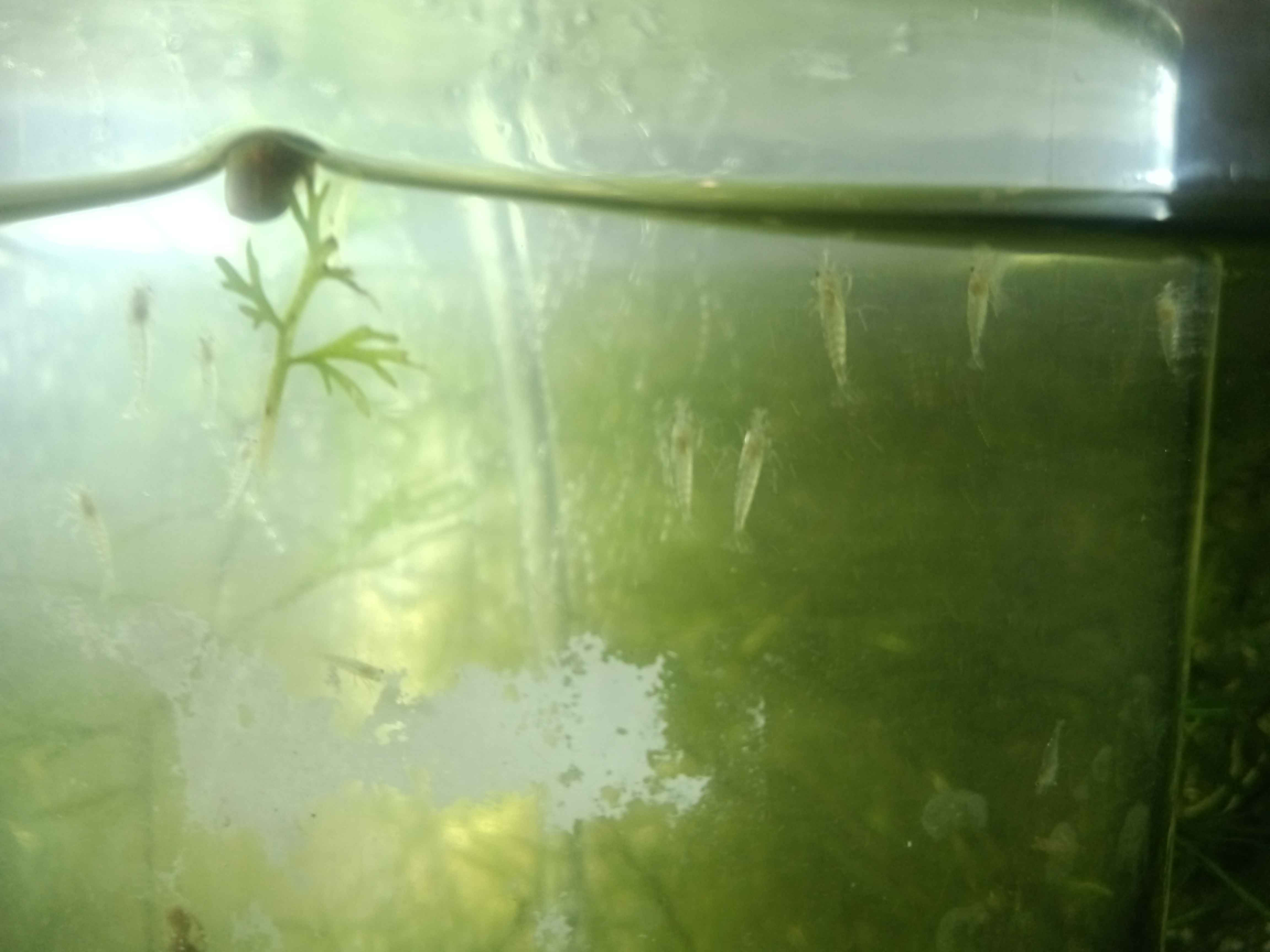
I have bred Neocaridina davidi/red cherry shrimp, yes the tiny guys that you can (and I have) thrown in a jar with some air, and watch them multiply. I have bred Amano shirmp as well, and I swear, despite the length of this post,
Amano shrimp have them
completely
beat on the quantity-to-effort ratio
.
In my last batch, which I did absolutely
nothing
to intervene with or control, only adding some preserved off the shelf food every now and then, at least 300 fully morphed and grew up.
This post is going to be
extremely
detailed, as I am sympathetic to those who have struggled with this. In such situations, nothing is more annoying than lacking information, and the internet is
severely
lacking in (good) information about this. It is easy to follow, and the length should not scare you off. If anything should scare you off, this should ⬇️
## Fair warning... ⚠️
##
Fair warning... ⚠️
How many more shrimp do you want anyway? 5? 10? 20? Despite what you may have heard, you are going to get far more, far easier, than with your neocaridinas. You should plan what to do with
at least 100 shrimp
. They are a bit small for human food.
## But first, a summary
##
But first, a summary
You should, probably, following this, be able to reliably breed amano shrimps, with no further information.
•
2 Containers/tanks
•
One with some salt (~25ppt), air bubbles directly out of the air tube, heater (~84f/29c) and a bright light
•
One with whatever bubbles you want, whatever you feed your shrimp
•
Throw fry food, and preserved "reef phyto" into salt tank as needed to keep it dirty
•
Suck up floating larvae from the freshwater using a flashlight and turkey baster, plop them in the saltwater
•
Net up shrimp from the salt, plop them in the freshwater
Any additional information is for clarity, and because this post functions for me to share what I learnt, and subtextually rant about it not having been shared already.
If you would like to skip a lot of the ranting, click here to skip to the
step by step, in detail
## Background info
##
Background info
First, here's some things I've learnt about breeding these shrimps, both from experiments and from research. After this, I'll provide a more detailed tutorial to replicate my results.
### Let's go over some myths
###
Let's go over some myths
>
Amano shrimp 'breed in brackish water'
Maybe in the same sense that the average person is half male and half female. Amano shrimp are born in
freshwater
, move to
saltwater
(or, true, brackish water), then
back to freshwater
where they breed and release more larvae. Averaging this out to say they "breed in brackish water", is
very misleading
. Only a small portion of their reproduction involves salt.
>
The water must be exactly [x] ppt
No. There may be some specifics involved with some other Caridina species, but Caridina multidentata (formerly Caridina japonica) AKA Amano shrimp, actually
do not really care
. Anything between 10-35ppt is probably fine for the shrimp (with
a caveat
). For reasons unrelated to osmotic requirements, I favor 25ppt.
>
Make sure to acclimate the larvae in / Make sure to acclimate the morphs out
No
. You are wasting your time, and slowing down getting them into the correct environment. They will
not
die from being quickly moved over. I have carefully observed this for hundreds of larvae and morphs, none have died.
>
At least make sure there are no large temperature swings
No. I mean you should keep the tank hot, but this won't kill them
>
You need a live tetraselmis/phyto culture
You
do not need a "live food culture"
and in fact this
might kill them
. I'm serious. I made it work once, but it's worse. Note that to properly make use of live food cultures, you need to be carefully controlling contamination, and measuring the exact density. If your source for why live food is good is not doing this, their results cannot be reproducible.
If you do not have bright lighting, your live food becomes dead food (though the contaminates will survive) as it enters your tank. If you
do
have bright lighting, dry food will also turn into algae too.
The 2 foods that work best (when used together) are the cheapest and easiest off-the-shelf foods. Keeping some assorted algae growths alive in your salty tank however,
is
important.
>
Non-live/preserved food will rot before being eaten
When I feed the 2 preserved foods I use, I do see most of the food being eaten quickly. There is leftovers, and these leftovers lead to large growths of every kind of algae,
not
ammonia/nitrite or even nitrate spikes. This is what the bright lighting is for.
>
Don't let the larvae settle on the floor or surface
Bro they are eating. Leave them be.
>
You need distilled or RO water
This
does
simplify measuring your salinity, improves your salt makeup, and makes algae growth more predictable. I have however tested with (awful off-the-charts hardness) tap water and marine salt, and it worked (tap water measured 4ppt salinity, this test was at a measured 35ppt).
>
You must remove fully morphed shrimp from salt instantly
The lower your salinity is, the longer you can take. You should not need to worry regardless.
>
Over 0ppm nitrate prevents proper egg release
I tested with 0ppm Nitrate, and at 40ppm (NO₃⁻/aquarium measurement, not scientifically common NO₃-N), no difference. Some (~15) larvae may be released early at random, but the rest will all be released in one single go. I cannot reproduce eggs going bad. If you are worried, make sure the adult shrimp have ideal water conditions and food for molting.
>
You need a filter
Your tank, air bubbler, lighting, and variance of algae comprise your "filter". If you use anything with a pump, it will shred up the shrimp. Sponges may trap the larvae, and make catching the morphed juveniles a pain. I prefer to keep the tank completely bare.
### Some more useful tidbits
###
Some more useful tidbits
#### Salinity and growth
####
Salinity and growth
The one thing it really changes, is how long the shrimp can grow in the salty tank. At 35ppt, you may have to remove matured shrimp at the perfect time (which is
slightly after
they become shrimp), but even going down to 25ppt lets the amanos grow almost up to the size of an adult neocaridina in the salty tank, preventing any urgency or ambiguity.
#### What water
####
What water
As mentioned earlier, RO or distilled water (I used distilled water gallon jugs from Walmart) is ideal. If you are using tap water, you must first dechlorinate it.
#### What salt
####
What salt
You should probably use marine salt, we know it works, but given they can mature in 10ppt water, I do wonder if marine salt is needed at all, but
this is untested
. If you choose to attempt with non-marine salt, you should probably
not
use RO or distilled water (or at least remineralize it), as you want some water hardness.
#### How much salt
####
How much salt
More seems to help keep your water stable, less lets shrimps grow for longer. 25ppt seems to be a nice sweet spot.
#### Catching the larvae
####
Catching the larvae
Don't try to use a net, either have the berried female in a small enough container that the whole thing can be dumped in, or suck them up (they are highly phototaxic. A flashlight and a turkey baster will work). You probably shouldn't just add salt to the tank they hatch in, as the undisolved salt may be harmful, the changes will mess with the algae, and this makes your setup disposable (more work next time).
## Step by step, in detail
##
Step by step, in detail
(and with my opinions and favorites injected)
When following my exact steps, I get shrimp survival and growth with more tolerance and success than is regularly reproduced in studies, so somewhere along the way, people must be assuming the wrong information. I am hoping the detail removes any ambiguity here.
I am not including exact measured amounts, not just out of lack of rigor, but also because it lacks importance. Things like food amounts I have experimented with varying drastically with no ill-effects.
### What you will need
###
What you will need
(assuming your shrimp do not live with fish)
Things have been link-ified to Amazon because I May As Well ™️, and these are the
exact
purchases I made, which I believed to be the best/cheapest. I will and would never link a product just to get the comission.
•
Spare fish tank (I got from LFS alongside wet rocks)
•
Salt hydrometer or refractometer (I got from LFS)
•
Turkey baster (I got from Walmart)
•
Tiny little dense net
(my actual purchase, other nets let shrimps escape or were too hard to catch with)
•
Bright ass light (I got from Aliexpress for $3 hooked it up to a 220v transformer)
•
"Reef phyto"/Preserved Thalassiosira
(my actual purchase, super happy to find the simplest product also works the best)
•
Fish Fry food/powdered fish food (I got from LFS)
### Salt tank preparation
###
Salt tank preparation
#### Add the salt
####
Add the salt
Dump in an amount of marine salt, approximately just under what should be needed for 25ppt following the instructions. Mix it in (I used strong bubbling and a paint-mixing drill attachment). Wait for the water to turn from cloudy to clear before taking measurements, and add more as needed to reach 25ppt.
#### Cycle it
####
Cycle it
"liquid bacteria" are
mostly
placebo (but are at least as effective as food), you just need to wait. If you are impatient, and want the healthiest tank, stop by your local saltwater aquarium store, buy a tiny little wet rock (my LFS gave me free rocks with a tank), and plop it in temporarily (bare tank is easiest to work with) during cycling/prep to speed things up. Food also helps.
#### Aeration
####
Aeration
You should not use an airstone. Just weigh the bare airline tubing down using whatever you feel like. I wrapped a "lead" strip (from aquarium plants) around the bottom of it. I have best success with extreme amounts of bubbles. As long as there are still places in your tank/container for the larvae to settle, absolutely blasting it works great.
#### Lid
####
Lid
You need a lid, it can be cling film, but trust me, you want a real lid. Despite the lid, still draw a line at the water level for water top-ups (...no, salt does not evaporate).
#### Lighting
####
Lighting
The more lighting you have, the more algae grows. That's why we limit lighting in our aquariums. Here, we are going to do the opposite. Ideally you should have bright 24/7 lighting.
You're going to feed so much that the water turns cloudy and/or green, and that's a dangerous state which can lead to ammonia/nitrite toxicity. Algae is not going to kill your shrimp, it will feed them. Run your lights 24/7 and you won't have to worry about your water going bad.
#### Heating
####
Heating
You need to keep the tank
"hot"
, around 84f/29c. The hotter the water, the faster they mature. The faster they mature, the less die. This is the highest I have tested with, and the temperature that has worked best.
### Feeding the salty tank
###
Feeding the salty tank
This section is
intentionally
before you acquire larvae. Those larvae want "dirty" water. You should see brown or green patches starting to appear on bare bottom glass, and the water appearing almost cloudy with microscopic floating particulate, before the first larvae is moved over.
As mentioned before, I have had the most success with fish fry/powder food (anything works, I got some local-label stuff labeled as "fry powder"), and preserved "Reef Phytoplankton"/Thalassiosira (The stuff that's in SeaChem's Reef Phytoplankton).
I used around half a cap of the preserved reef phyto daily, until the water started showing a green tinge under a flashlight, and the flowing cloudy particles.
Once the water and tank is starting to look mature/dirty with food, your schedule does not matter too much. I have varied this a
lot
, and it has little effect unless you turn your water absolutely toxic, or don't feed for a week. My preference is 1/4 a cap of phyto (8 gal tank) every ~4 days, and enough powder to spread across the surface of the tank.
The dirtier/greener/cloudier/browner your tank looks, the less you have to worry about feeding.
### Conditions for acquiring larvae
###
Conditions for acquiring larvae
Adult female amano shrimp remain "berried" with larvae for ~30 days depending on conditions, mostly temperature. They should become berried again (obviously assuming a male is present) around 3 days later. The hotter the tank is, the faster this process should be. I keep mine around 84f/29c.
This tank must have
no fish
. Amano larvae are the ideal perfect fish food, and any fish would eat them
long
before they expire in freshwater.
Your "tank" can be anything for this. I have used a water pitcher. Aeration is a requirement, and more
may
slightly prolong larvae survival.
You will want to check this
at least once a day
for larvae, as they die quickly (around 24 hours, probably).
### Getting salty
###
Getting salty
You'll want to grab a flashlight for this, brighter is
not
better, as it will reflect all over the inside of the tank/container and confuse the larvae. The larvae are strongly phototaxic and will swarm around any light source.
Spotted
a few
larvae? Your shrimp is still berried? This is ok. Some will drop off and hatch into larvae before the shrimp "releases", this is no cause for alarm, and given the huge amount you're about to have, you
do
have the option of... ignoring them. Personally, I move them over to the salt regardless, feels rude not to. When your shrimp
does
release, it will not be gradual, it takes about 3-30 minutes, and all the eggs will almost instantly hatch into swimming larvae.
I hope you left your flashlight sitting for a long enough time to gather them all. You should now be able to suck them up with your turkey baster, and plop them into your salt water.
### Patience
###
Patience
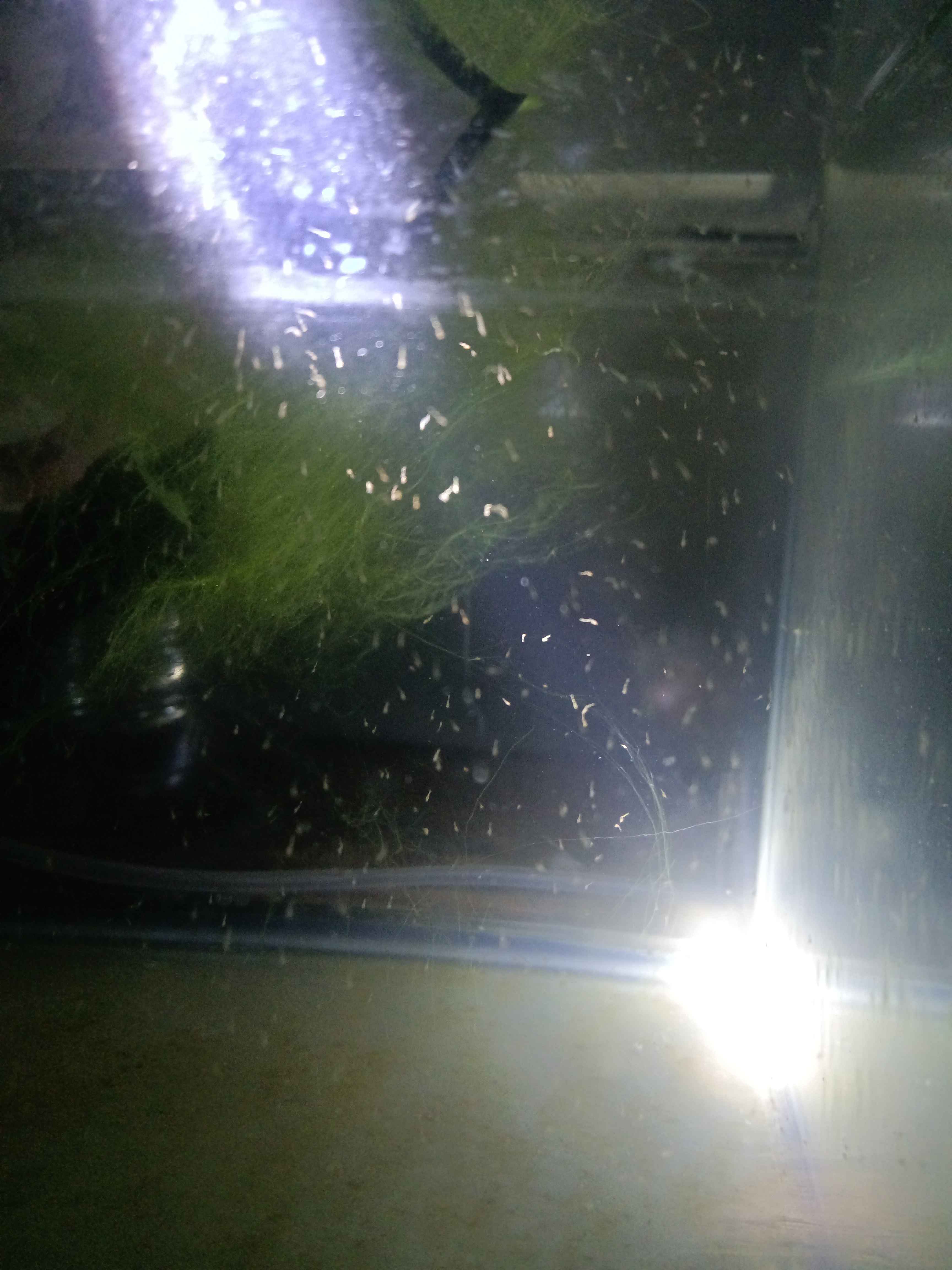
They will change color, change size, change orientation, change behavior, and do all kinds of things, none of this matters.
Are they "stuck" on the top? settled in a corner? I don't care, they are probably fine. If it's a concerning amount, try to pump some more air in there.
You
think
one looks ready? No, you have been staring at them for too long, it would not just look kinda-shrimpy, you would recognize it as completely morphed and changed.
### Holy shit there's a shrimp
###
Holy shit there's a shrimp
It's got shrimp legs, its phototaxis is now
negative
and tries to escape the light, it never floats, only zooming whenever it briefly swims, it's definitely a shrimp, very clearly.
I've noticed most morphed shrimp first go colored (green/brown/red depending on food), then clear and slightly larger. Ideally you want to remove these larger transparent morphs.
You
can
move it now and it will
probably
survive. But if you're at 25ppt, I personally wouldn't, and you have at least a week before you should worry about it. You won't need to squint, it should double in size long before it has any chance of dying.
### The last step
###
The last step
You now need to catch your shrimp, which have turned from being slow, attracted to light, and colored, to completely transparent, great at hiding, and speedy escape artists.
If you lose one trying to catch it, knock on the tank, squirt some water at the corners and hard to see spots with your turkey baster, and just poke around everywhere to scare it into zooming again. They are easiest to catch when settled on the floor, as you can just swoop them straight up and out of the tank.
### ...uh oh
###
...uh oh
Figure out what to do with ~300 shrimp.
#### A suggestion
####
A suggestion
I used to be a big fan of introducing scuds to aquariums with fish, as a way to feed off of crumbs, dirt, dying algae, etc, and turn it into fish food (the scuds themselves).
I found that Amano shrimp are far better for this. The adults will constantly roam around your tank, cleaning it ferociously, and spewing out little floating larvae which swim around akin to baby-brine-shrimp, which your fish will happily gobble up in an instant. They can eat in more places without being eaten instantly, and cannot be hunted to extinction (unless your fish eat things amano shrimp sized, in which case they probably wouldn't care for scuds, and you found what to do with
all
your amanos).
Having many of the relatively large (compared to Neocaridina) Amano shrimp roaming your tank also looks rather cool, they have very interesting behavior, and they aren't going to impact your tank's bio-load
much
(though they may more frequently disturb pits of mulm that may be binding some nitrogen compounds and carbon).
#### TODO
####
TODO
figure out what to do with the remaining ~280 shrimp.